
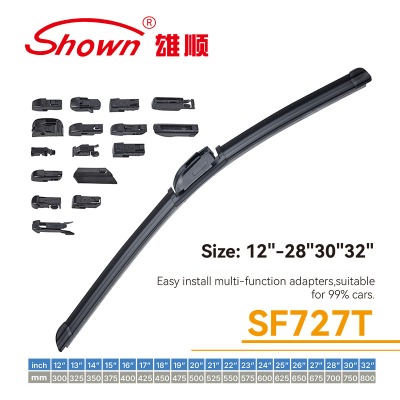
Flat wiper blades, universally defined as beam blades in the automotive parts industry, are standard factory supporting parts for most modern passenger vehicles. SHOWN wiper blade factory produce many wiper blades,New Toyota wiper blade, New Mercedes-Benz wiper blade,BMW 5 Series wiper blade , Audi wiper blade,Ford Ecosport wiper blade and Golf wiper blade etc.They adopt a fully frameless integrated structure, optimized for mainstream streamlined vehicle designs.
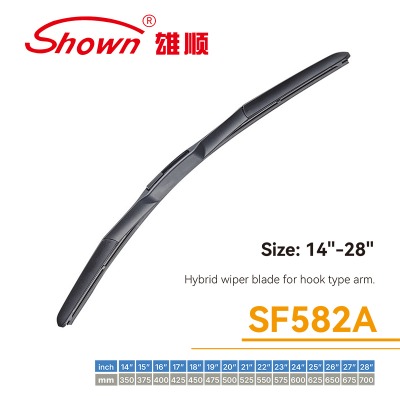
Hybrid wiper blades are a transitional optimized structure developed by factories to solve the matching pain points of flat blades on special curved windshields. In terms of appearance, they retain the streamlined aerodynamic outer shell of flat blades, abandoning the bulky exposed frame of traditional wipers, which is more in line with modern vehicle appearance design standards.
The difference of flat and hybrid wiper blades as follows:
1. Fit & windshield contact performance
Flat Blades: Designed for low-curvature flat windshields of new vehicles; limited fitting ability for large-arc glass, prone to end lifting.
Hybrid Blades: Multi-point pressure adaptation, compatible with all types of windshield curvature, realizing full-surface fitting without blind areas.
2.High-speed operating stability
Flat Blades: Aerodynamic shell reduces wind lift with low noise, suitable for conventional high-speed working conditions.
Hybrid Blades: Reinforced internal structure improves rigidity, stronger anti-flutter and anti-vibration ability, adapting to complex airflow environments.
3.Environmental adaptability (snow, ice and dust)
Flat Blades: Fully enclosed seamless structure, excellent anti-clog and anti-icing performance, suitable for extreme cold weather.
Hybrid Blades: Limited gap anti-fouling ability, stable in mild weather, easy to accumulate dirt and ice in severe snow conditions.
4.Structural durability & failure rate
Flat Blades: Few parts, no exposed corrosion points, uniform wear and low long-term failure rate.
Hybrid Blades: Sturdy overall structure, but internal assembly gaps have hidden corrosion risks in humid and snowy environments.
From automotive parts R&D and production perspective, there is no absolute distinction between good and bad flat and hybrid wiper blades, only structural matching and scenario adaptation.
Flat beam blades are optimized for modern vehicle streamline design and extreme cold weather, relying on seamless integrated structure to achieve ultra-high environmental adaptability. Hybrid blades are engineered as a targeted optimization solution for curved windshield matching defects, balancing appearance, stability and universal compatibility, making up for the scenario limitations of flat blades.
Standardized accessory matching is the core of stable wiper performance. Blindly pursuing high-priced flat blades or low-cost hybrid blades will lead to insufficient fitting performance or wasted performance. Only selecting according to vehicle structure and regional climate can maximize the service life and wiping effect of wiper blades.


 IPv6 network supported
Blog
| Sitemap
| XML
| Privacy Policy
IPv6 network supported
Blog
| Sitemap
| XML
| Privacy Policy
Scan to WhatsApp :

 English
 English
 Français
 Pусский
 Español
 中文
中文